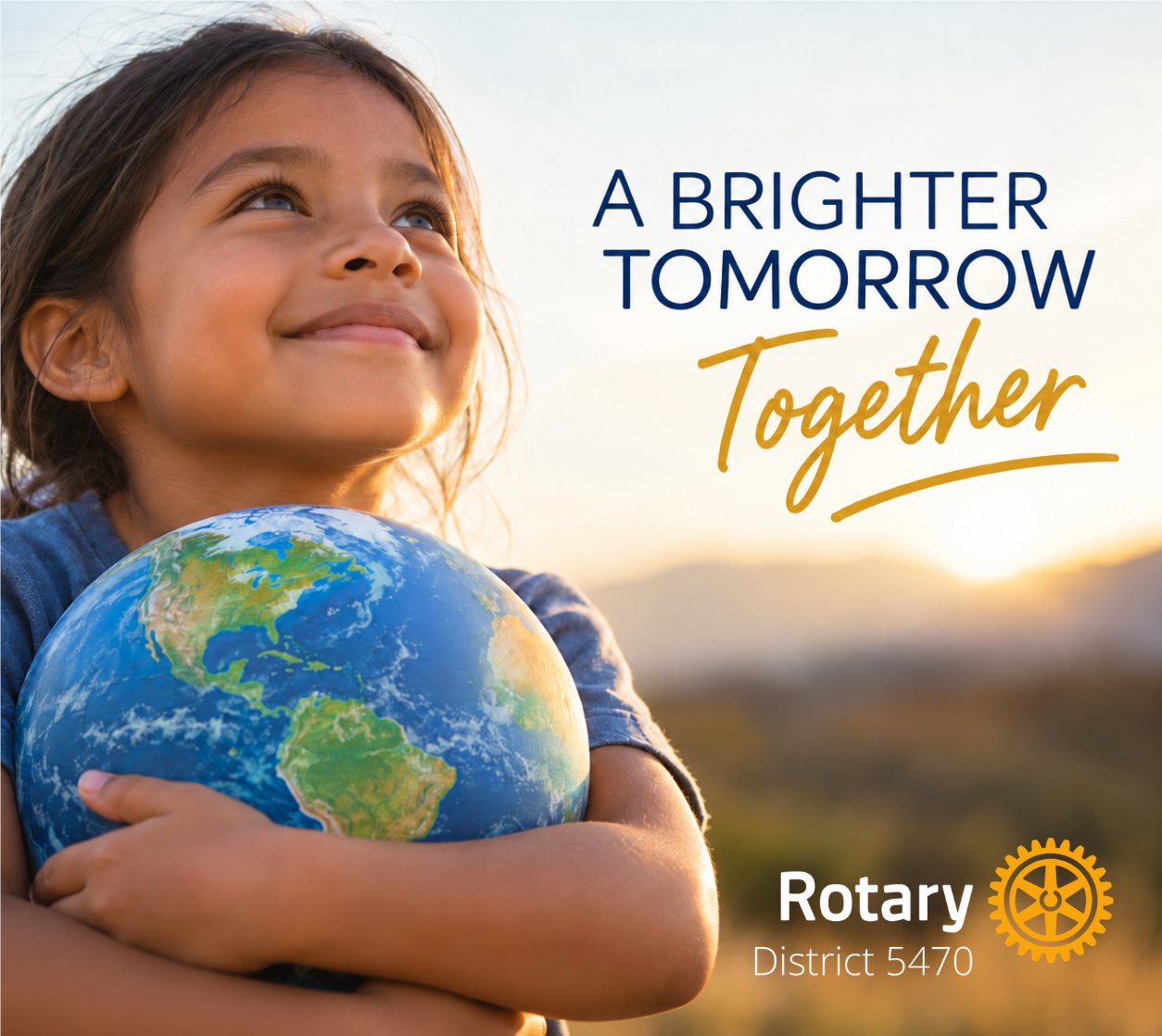
A child returns to school after surgery. A premature newborn has access to lifesaving equipment. A family turns on a tap and drinks safe water. A rural student opens a computer for the first time. Behind every Global Grant is a need, a partnership and Rotarians who decided they could do something about it.
Last year, Rotary District 5470 helped support 14 Global Grants with $60,095 in District Designated Funds.
That is an impressive number.
But it is not really the story.
The story is what happens after those dollars leave a spreadsheet.
They become orthopedic surgery for a child in Mexico. They become counseling in a rural Ugandan health clinic. They become books in a Guatemalan classroom, an incubator for a premature baby in Lebanon, safe drinking water in Colombia and technology connecting students in remote areas of Panama to a world of information.
They become Rotary doing what Rotary does best: bringing people together across clubs, districts, countries and cultures to solve problems that are too big for any one of us to solve alone.
And behind every one of those grants is something perhaps even more important than money: caring.
Changing a child’s future
Consider Transformando Vidas, a project supported by the Rotary Club of Pueblo West in partnership with Rotarians in Mexico.
Its goal is not simply to perform orthopedic surgeries. The project is designed to help children with orthopedic conditions more fully participate in their families, schools and communities.
Each year, the program plans for pre-evaluations, specialized consultations, surgeries, physical therapy, splints and mobility equipment. Ten children are expected to receive surgery annually, but the impact extends well beyond those 10 patients.
The project’s own description measures success in beautifully practical terms: children being able to return to school and parents being able to return to work.
That is the ripple effect of a Global Grant. Treat one child, and an entire family may begin moving forward again.
Another project, Corazón de Niños, focuses on children in Ciudad Juárez and Chihuahua born with congenital heart disease. The project anticipates helping provide 21 heart surgeries, along with medical evaluations, supplies and assistance with transportation and lodging for families who must travel for treatment.
The lodging matters. The transportation matters.
Because caring for a sick child is not simply a medical problem. Rotary sees the family standing beside the hospital bed, too.
The smallest patients
Thousands of miles away, the Rotary Club of Grand Junction is helping support another kind of lifesaving care.
A Global Grant in Lebanon will provide two modern neonatal incubators to Ain Wazein Medical Village Hospital, along with hands-on training for nurses, midwives and physicians.
The equipment is expected to serve approximately 200 vulnerable newborns each year, particularly premature and low-birth-weight babies, while training 10 to 15 healthcare professionals who will continue using that equipment long after the grant is completed.
Two pieces of equipment.
Two hundred babies a year.
Suddenly, the mathematics of Rotary begins to look very different.
Creating health where the need is greatest
In Mayuge, Uganda, the Rotary Club of Carbondale is involved with a project confronting three interconnected challenges: malaria, sickle cell disease and malnutrition.
Rather than treating them in isolation, the project is taking an integrated community-health approach. Village Health Teams will be trained and equipped, community education will be expanded, and the Mayuge Health Center will ultimately continue the work.
The anticipated reach is enormous: 14,000 direct beneficiaries in more than 6,700 households, primarily children and pregnant women.
Another Ugandan project supported by Pueblo 43 is addressing a need that can be less visible but equally life-changing: mental health care.
In Ngora District, where access to services is limited, the project plans to train more than 15 peer counselors and health workers, provide more than 3,000 counseling sessions at 10 health facilities, reduce stigma and create referral networks within the existing public health system.
That last piece is important.
Global Grants are not designed to arrive, do good for a year and disappear.
Again and again in the grant requests submitted to District 5470, there is an emphasis on training local people, building local expertise and putting systems in place so communities can continue the work themselves.
An education that keeps giving
Few projects illustrate that philosophy more clearly than the Guatemala Literacy Project.
Led within District 5470 by the Rotary Club of Fruita, with participation from other district clubs, the project combines literacy, textbooks, technology, teacher training, mentorship and scholarships.
The numbers are substantial. The Spark Reading Program plans to train 180 elementary teachers in 28 schools, benefiting approximately 3,872 students. A youth development program will provide mentoring and scholarship support to approximately 1,270 Indigenous students in 19 communities.
Yet what makes the project especially powerful is what happens after Rotary funding.
Teachers learn how to maintain technology. Students and schools learn to care for books. Communities establish self-sustaining book cooperatives. Parents participate. Local knowledge remains behind.
In other words, Rotary is not simply delivering resources.
It is helping communities build the capacity to carry their own success forward.
The same philosophy is at work in rural Panama, where the RACHEL Growing in Panama project plans to bring offline digital learning servers, laptops and backup power to 50 additional remote primary schools. Teacher training and ongoing monitoring are built into the project, with an anticipated reach of as many as 200 teachers and 2,300 students annually for at least five years.
Water changes everything
Then there is something most of us encounter so routinely that we rarely think about it.
Water.
In the villages of El Nogal and La Carrera in Colombia, approximately 1,200 people in 250 homes and two schools are expected to benefit from a proposed potable water treatment plant.
But Rotary’s plan does not end when the plant is switched on.
Members of the local Water Board will be trained to operate and maintain it. Residents will receive education about sanitation, hygiene and responsible water use. The goal is not merely to install equipment, but to reduce disease and create a healthier community for years to come.
That is sustainability in its most understandable form: leave behind more than what you built. Leave behind the knowledge to keep it working.
Other water projects supported through the district tell much the same story.
In Mexico’s Sierra Madre Copper Canyon region, Dancing for Rain seeks to help Indigenous Rarámuri families collect rainwater from roofs in communities where families may otherwise walk long distances to obtain water, sometimes from unsafe sources. The project incorporates training, maintenance and local involvement so families can continue managing the systems themselves.
Another project, Clean Water Healthy Children, is designed to provide water purification systems in schools in Saltillo, Mexico, improving access to safe drinking water while reducing dependence on bottled water and teaching students and staff about hygiene, maintenance and sustainability.
Different countries. Different communities. The same Rotary idea: listen first, work together and create something that lasts.
The Rotarians behind the grants
None of these projects happens simply because funding is available.
Behind each Global Grant are Rotarians who identify a need, build partnerships across districts and countries, develop budgets, document community support, demonstrate sustainability and work through a detailed application process with The Rotary Foundation.
For District 5470 Global Grant Chair Melanie Phelps, that dedication is one of the most inspiring parts of the program.
“The people I feel so honored to work with and am so proud of are the clubs that sponsor these grants, and especially the grant writers, who spend so much time, thought and effort to help other people,” Phelps said.
Those grant writers may never meet every child, parent, teacher, healthcare worker or family ultimately touched by their work. But their hours of research, correspondence, planning and persistence become something very real on the other side of the world.
A water treatment plant.
A classroom filled with books.
A counselor trained to help someone struggling with trauma.
An incubator waiting for the next premature baby.
A surgery that gives a child a different future.
And those efforts rarely belong to just one club.
The funding plans themselves reveal networks of Rotary clubs, districts and community partners contributing amounts large and small toward a common goal. The Guatemala Literacy Project, for example, anticipated participation from close to 100 Rotary clubs, while projects in Mexico, Colombia, Uganda and Lebanon similarly bring together Rotarians from multiple districts and countries.
That collaboration is part of the power of a Global Grant.
A club does not have to solve the whole problem.
It has to be willing to become part of the solution.
Our Foundation at work
For the 2026-27 Rotary year, District 5470 has $117,507.18 in District Designated Funds, divided between the District Grant and Global Grant programs.
Those funds exist because Rotarians have supported The Rotary Foundation.
Somebody gave to the Annual Fund years ago. Somebody became a Paul Harris Fellow. Somebody made a recurring contribution. A club decided that supporting The Rotary Foundation mattered.
Later, a portion of those gifts came home to our district as District Designated Funds.
And then something remarkable happened.
Those dollars went back out into the world carrying our district’s fingerprints with them.
Last year alone, District 5470 supported 14 Global Grants with $60,095 in DDF.
But those numbers represent something much larger: Rotarians throughout our district choosing to invest their time, expertise and Foundation resources in people and communities far beyond their own hometowns.
Because these grants tell us something about District 5470.
We care about a child we may never meet.
We care whether a mother in Uganda has access to healthcare, whether an Indigenous student in Guatemala graduates from high school, whether a premature baby in Lebanon has an incubator, whether a family in Colombia can safely drink its water and whether a child in Mexico can walk back into a classroom after surgery.
There may be oceans and borders between us.
Rotary has never been particularly impressed by either.
When Rotarians combine compassion with partnership, expertise and The Rotary Foundation, a contribution made here can become lasting impact almost anywhere.
Learn More About Global Grants
Interested in learning more about Global Grants or exploring opportunities for your club to participate in an international service project? Contact Melanie Phelps, Chair of the District 5470 Global Grants Committee, at melaniephe@aol.com for information and guidance or visit https://rotary5470.com/sitepage/global-grants/.
Your Donations Make Global Grants Possible
Every contribution to The Rotary Foundation helps turn service ideas into lasting impact. To support projects in our district and around the world, visit rotary.org/donate and select Annual Fund–SHARE. You can make a one-time gift or arrange recurring contributions through Rotary Direct or contact Maile Foster: D-5470 Rotary Foundation Chair, at mailefoster.rotary@gmail.com. Your generosity helps provide the funding that makes both District and Global Grants possible.