Pagosa Springs Rotary project will provide laboratory equipment and hands-on training to teachers from 23 West African high schools
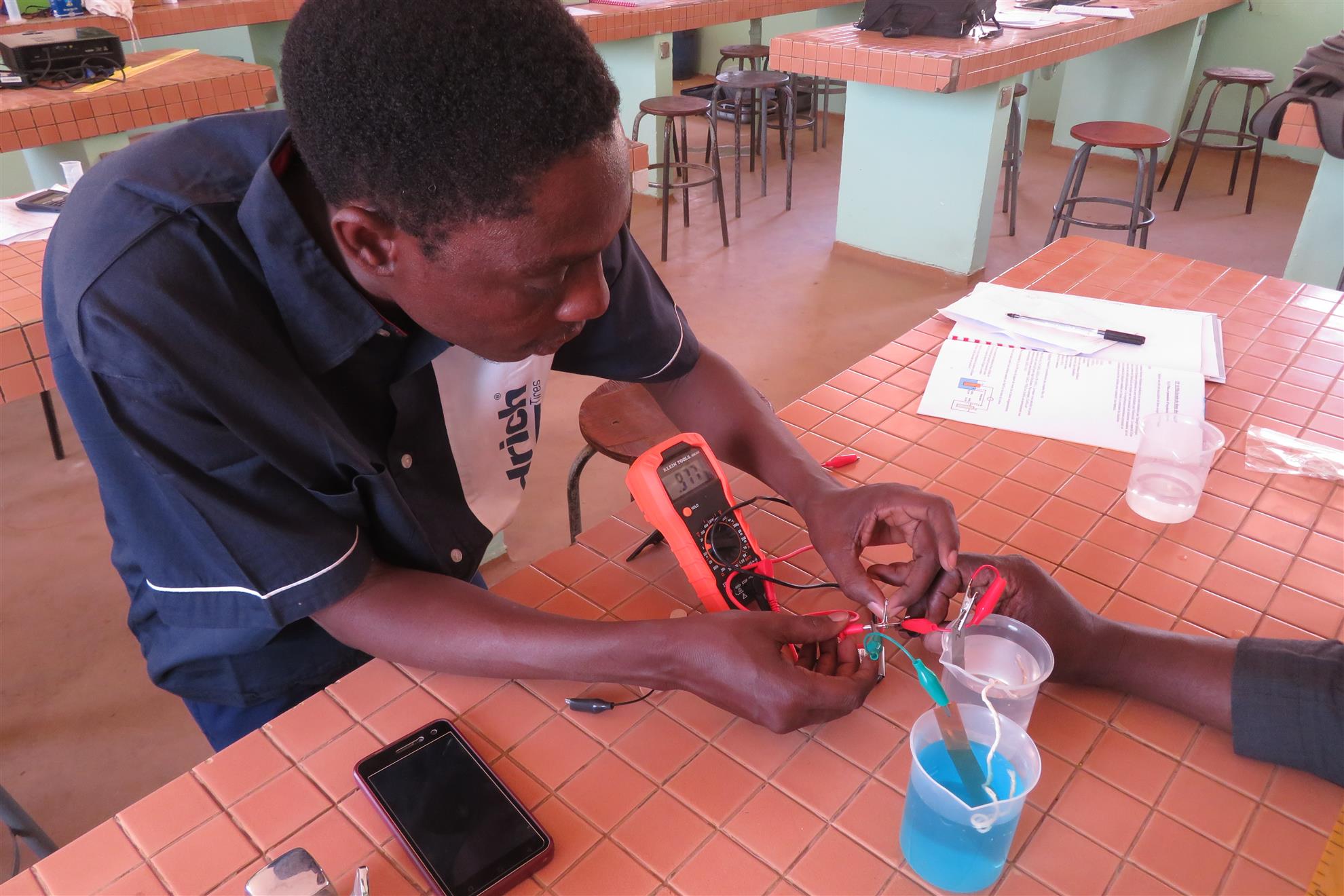
Teachers use copper sulfate and zinc sulfate half-cells to make a battery that illuminates an LED.
These teachers have taught the theory of batteries, but have never built one.
Photo from 2023 workshops in Niger.
Rotary Club of Pagosa Springs
Six boxes packed in Pagosa Springs will soon begin a journey to Togo, a narrow West African nation on the Gulf of Guinea, bordered by Ghana, Benin and Burkina Faso.
Inside the boxes are multimeters, magnets, lenses, pulleys, test tubes, electronic scales and thousands of other pieces that will be assembled into laboratory kits for 23 high schools.
There are also supplies that might seem more at home in a kitchen drawer, garage or classroom cabinet: rubber bands, string, graph paper, baking soda, table salt, vinegar, a flashlight, a compact disc and even a tin can filled with cement.
Together, the ordinary and specialized items will allow science teachers to demonstrate more than 50 chemistry, physics, biology and earth science experiments that most of their students have never had the opportunity to see.
The equipment is part of a $58,064 Rotary Foundation Global Grant led by the Rotary Club of Pagosa Springs and the Rotary Club of Dapaong, Togo.
Pagosa Springs Rotarian David Smith will spend nearly five weeks in Togo helping conduct three teacher-training workshops beginning Aug. 17. Approximately 70 science teachers from 23 high schools in the Savanes region of northern Togo are expected to participate.
The Savanes region, located near Togo’s border with Burkina Faso, was selected because it is the country’s least-developed region.
Where is Togo?
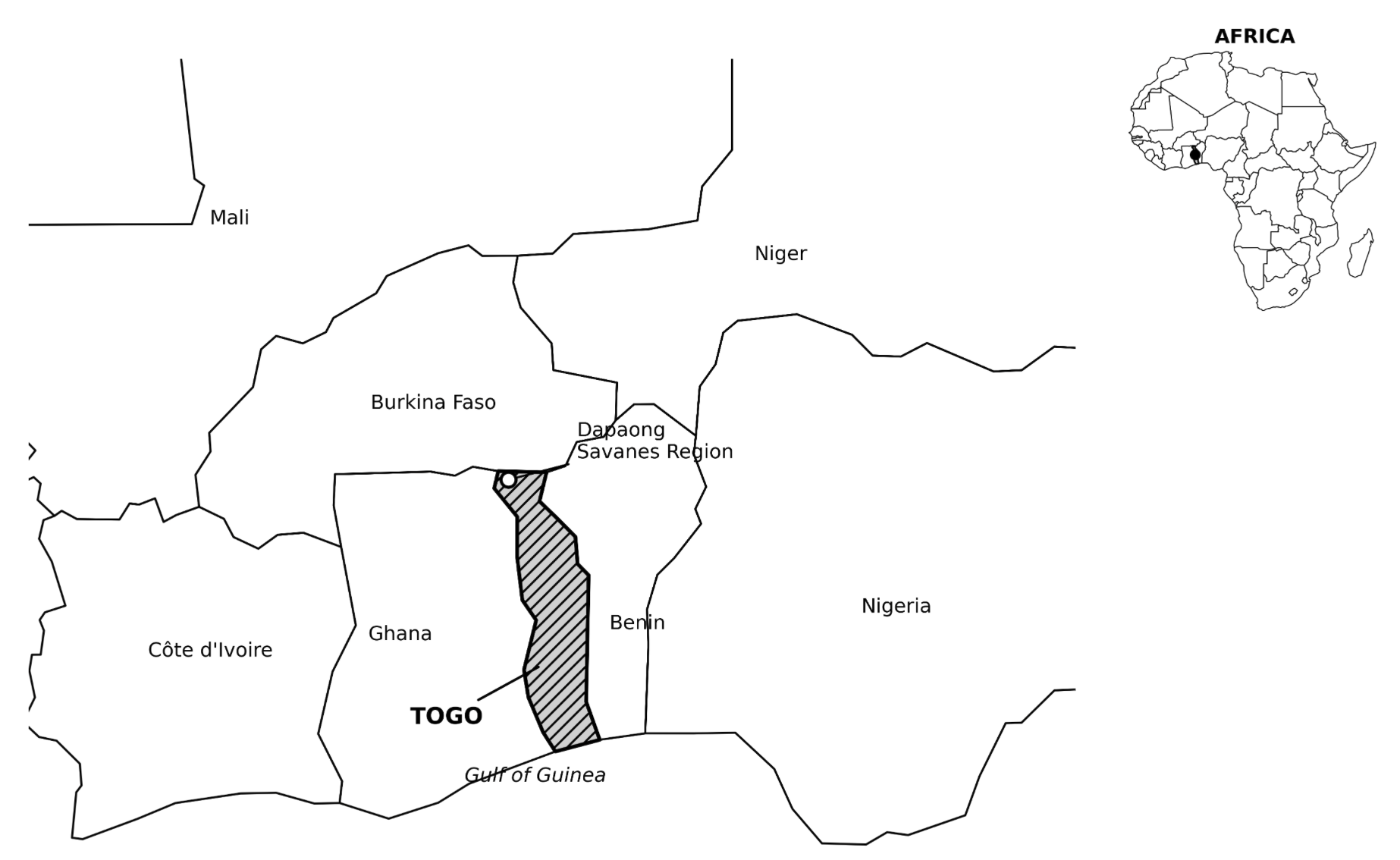
Togo is a narrow West African nation on the Gulf of Guinea. Dapaong, in the northern Savanes region near the Burkina Faso border, is the base for the Rotary teacher-training project.
The project has taken nearly three years to reach this point.
Laboratory manuals have been written and revised. Materials have been purchased, sorted and repacked. More than 4,000 individual items are being organized into 46 science kits, two for each participating school.
Three of the six boxes will travel with Smith as checked baggage. Exactly how the remaining three boxes will reach Togo is still being determined.
Moving approximately 300 pounds of equipment across continents and through customs is one of the final logistical challenges in a project that has already required hundreds of decisions, countless emails and cooperation among Rotarians in several countries.
“Developing and executing these projects is similar to building a house,” Smith said. “There are a thousand steps, each with its own challenges.”
Beyond chalkboards and memorization
Science instruction in many West African schools bears little resemblance to what students in the United States would recognize as a laboratory class.
Smith will have a clearer understanding of conditions in the participating schools after he arrives. Based on information from the Rotary Club of Dapaong and his previous work in Senegal and Niger, however, he expects many classrooms to have little more than chalkboards and chalk.
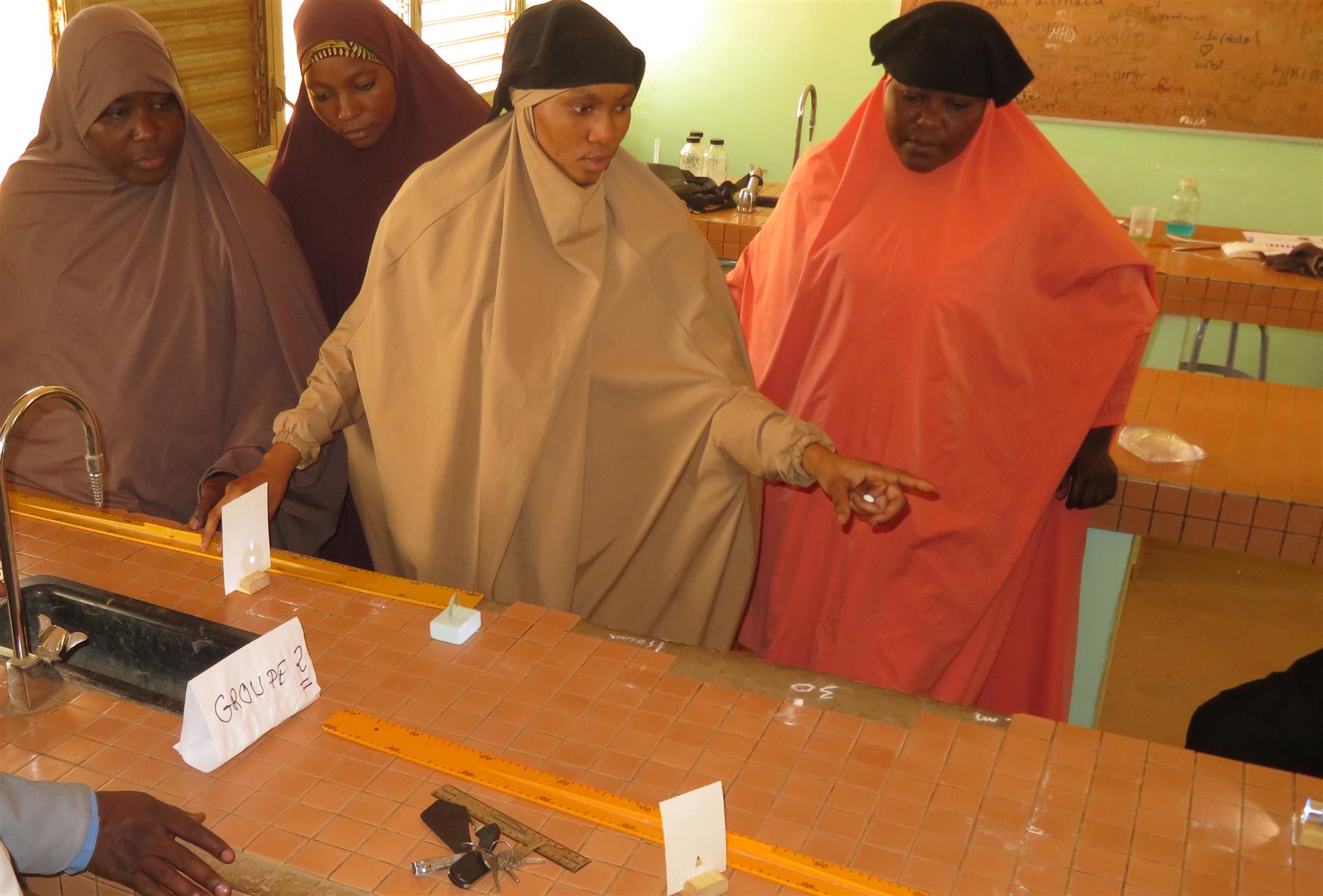
A physics teacher demonstrates how a double convex lens can be used to enlarge or reduce an image.
Students pursuing a career in optometry need to understand the focusing properties of lenses.
Photo from 2023 workshops in Niger.
Teachers commonly spend part of each class dictating information while students copy it into notebooks. Students memorize the material and work problems, sometimes at the blackboard, but most schools lack the equipment needed to perform or demonstrate laboratory experiments.
Laboratory manuals that correspond with the national science curriculum have also been unavailable.
Students may learn the theory behind electricity, magnetism, chemical reactions or the behavior of light without ever holding a multimeter, looking through a lens or watching an experiment confirm what they have been taught.
“Laboratory experiments have become an essential part of science education because they help students understand theory, develop skills they will need in future careers and think creatively,” Smith said.
Each of the 23 schools will receive one physical science kit for chemistry and physics and one kit for earth science and biology.
The physical science kits include materials for studying mechanics, electricity, electrochemistry, light, magnetic fields and chemical reactions.
Teachers will be able to demonstrate mechanical principles using pulleys, weights, rulers, an inclined plane, rubber bands and objects of equal mass.
The electronics materials include multimeters, power sources, wires, resistors, potentiometers, capacitors and several types of diodes.
Electrochemistry experiments will use carbon electrodes, copper and zinc strips, low-power LED lights and other materials. Light studies will incorporate a laser pointer, lenses, a semi-cylindrical tank, a flashlight, a screen and a compact disc.
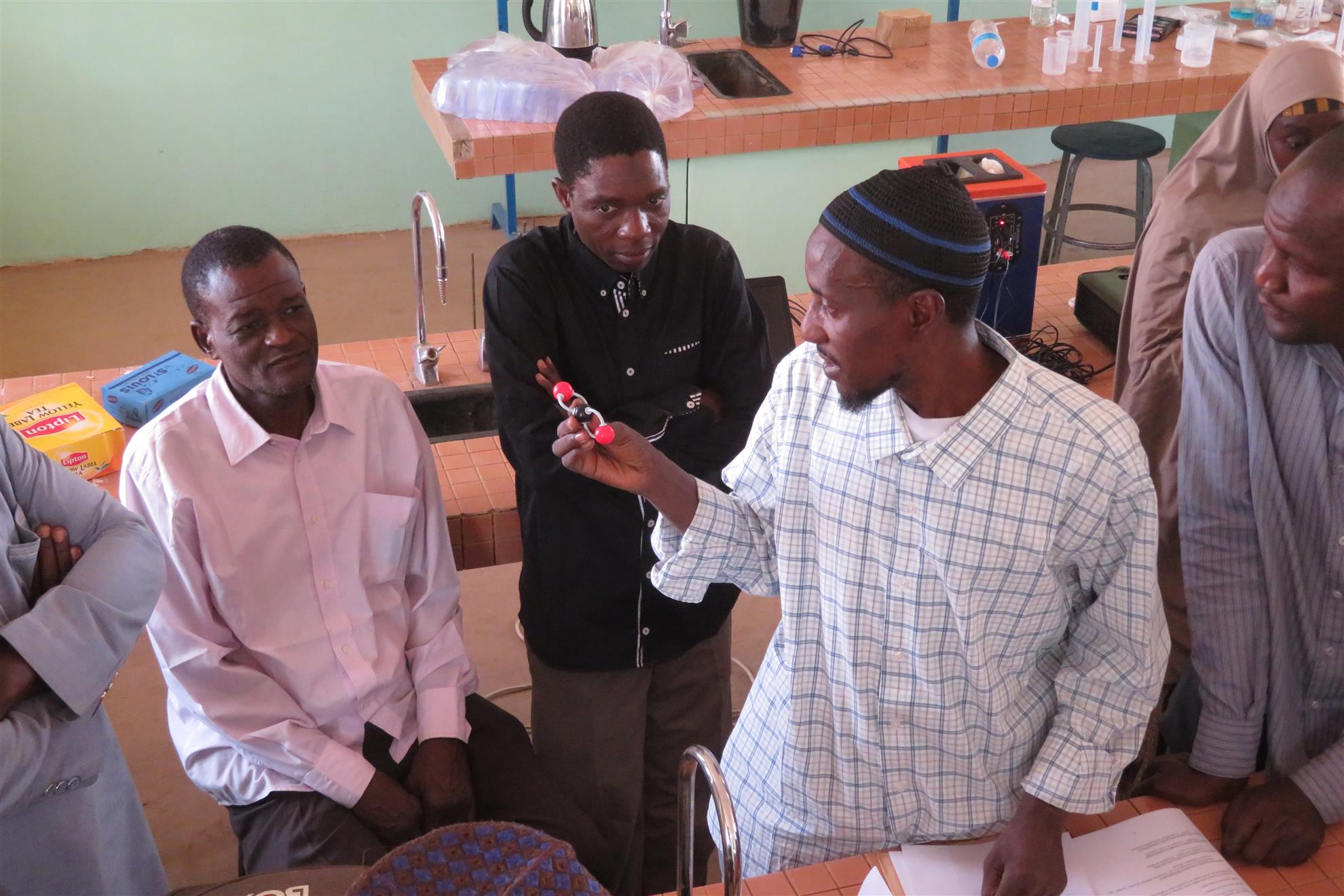
A teacher uses parts of a molecular model kit to illustrate the linear structure and two double bonds characteristic of a molecule of carbon dioxide.
Such structural information will help these teachers to explain why carbon is a green-house gas.
Photo from 2023 workshops in Niger.
The magnetic field supplies include a bar magnet, compass, iron filings, insulated wire, a neodymium magnet and an aluminum rod.
Chemistry materials include test tubes, beakers, transfer pipettes, graduated cylinders, pH paper, a pH meter and an electronic scale. Chemical supplies include baking soda, salt, sodium hydroxide, copper sulfate, zinc sulfate, hydrochloric acid and vinegar.
General supplies range from graph paper and protractors to paper towels, screwdrivers and molecular model kits.
Many of the experiments were designed around materials that are durable, affordable and relatively easy to replace. That is important in schools where ordering a specialized replacement part may be difficult or impossible.
Each physical science kit will contain the materials needed to conduct 30 experiments. The earth science and biology kits will support another 21 experiments.
A few of the participating schools already have computer facilities. Schools without those resources will receive a computer, projector and video camera to support classroom instruction and demonstrations.
A three-step project
The project has been carried out in three stages.
The first was the development of laboratory manuals that match Togo’s high school science curriculum.
The Rotary Club of Pagosa Springs had already developed manuals for similar projects in Niger. Because the Togolese and Nigerien science curricula are similar, those manuals could be adapted rather than created entirely from scratch.
Science inspectors from Togo’s Ministry of Education helped guide the revisions.
Separate manuals were developed for physical science, which includes chemistry and physics, and for SVT, the French abbreviation used for biology and earth science.
The second stage involved purchasing the materials needed for the experiments and organizing them into kits for each school.
Those first two stages are essentially complete.
The final stage begins Aug. 17 with three weeklong teacher-training workshops. Each workshop will provide 20 hours of instruction.
Physical science and earth science and biology workshops will be held at the same time at one of the participating high schools.
During the first week, four physical science teachers and four earth science and biology teachers will receive intensive training. Those eight teachers will then help train approximately 70 additional teachers during the following two weeks.
The train-the-trainer approach is intended to give the project a life far beyond the initial workshops.
The first eight teachers will remain in Togo after Smith and the other trainers leave. They will be able to assist colleagues, resolve problems and train additional teachers in the future.
Smith will conduct the physical science workshops. A representative of Togo’s Ministry of Education will lead the earth science and biology training.
Smith and Yobe Koumbouni, his Rotary counterpart in Dapaong, are responsible for organizing the workshops.
For Smith, working directly with the teachers will be the most meaningful part of the project.
“I know most of the teachers will use this program to improve their teaching,” he said.
Reaching students for years to come
Approximately 2,300 students are currently enrolled in the 23 participating high schools, but the eventual number of students who benefit from the project could be much larger.
“We teach the teachers,” Smith said. “Their contribution occurs year after year for as long as they are teaching. Furthermore, they will likely teach new teachers who will continue the process.”
The Rotary Club of Dapaong will distribute a one-page questionnaire at the end of each workshop and again one year later.
The surveys will ask teachers how they are using the equipment and whether the training has improved science instruction.
Smith said previous projects in Senegal showed that giving teachers practical training and the ability to conduct experiments increased student interest in science classes. Teachers also reported increased enrollment in science courses.
The immediate goal in Togo is to help students understand the connection between scientific theory and what happens in the physical world.
The larger goal is to strengthen education, critical thinking and economic opportunity.
Students hoping to become physicians, nurses, engineers, public health workers or other technical professionals need a solid foundation in science.
A shortage of technically trained workers is also frequently cited as a barrier to investment and economic development in Africa. Factories, infrastructure projects and other major investments are difficult to sustain without workers who are prepared to operate, maintain and improve them.
High-quality science education at the secondary level is one part of developing that workforce.
The program is intended to improve students’ scientific skills and encourage more of them to pursue science-based careers.
Even students who choose other fields will benefit from learning how to evaluate evidence, solve problems and make decisions based on science, Smith said.
The full economic effects will not appear immediately. Students must finish high school, continue into universities or technical programs and eventually enter the workforce.
Smith believes that long timeline does not make the investment any less important.
“Our optimism for success is built on a foundation of experience, fact and logic,” he said.
More than a decade of work in West Africa
The Togo project grew from an international effort that began within the Rotary Club of Pagosa Springs more than a decade ago.
The club’s International Committee was formed around 2012, near the beginning of The Rotary Foundation’s Global Grant program.
Committee members considered three primary factors when choosing where to focus their work: the level of poverty, safety and opportunities to build greater understanding between Muslim and non-Muslim communities.
Senegal became the club’s first target country.
Glenwood Springs Rotarian Peter Jeschofnig connected the committee with Judy Beggs, a Rotarian who had served in Senegal as a Peace Corps volunteer.
Beggs introduced the group to Khoudosse Cissa, a rural school superintendent, and members of the Rotary Club of St. Louis, Senegal.
Those relationships led to four Global Grants for science education in Senegal between 2014 and 2016.
The Rotary Club of Pagosa Springs later participated in a $59,578 project to strengthen secondary-level science education in Niger.
The current Togo project and another recently funded project in Niger continue that work. The newest Niger grant has a budget of $103,980.
The club has also participated in international projects in Nicaragua and Argentina initiated by former Pagosa Springs Rotarian Marie Munday.
Working in French-speaking countries adds difficulty to every stage of the process. Grant applications, laboratory manuals and instructional materials must be written in French, and the teacher-training workshops are conducted in French.
Smith believes that challenge is also one reason the Pagosa Springs club’s work is especially valuable.
Many Rotary clubs prefer to undertake projects in English-speaking countries. Fewer are prepared to develop technical materials and conduct training in French-speaking communities.
A partnership crossing continents
The Togo project began through a longstanding relationship between the Rotary Club of Quebec, Canada, and the Rotary Club of Dapaong.
The Rotary Clubs of Pagosa Springs and Dapaong share responsibility for managing the project. The Rotary Clubs of Quebec and West Lake Village, California, are also project partners.
Additional financial support came from Rotary clubs in Belgium and Taiwan.
The international partnership demonstrates one of Rotary’s strengths: A club in a small Colorado community can work with partners across several continents to undertake a project that no single club could accomplish alone.
The $58,064 grant also demonstrates how local contributions can be multiplied through The Rotary Foundation.
The project required $19,428 in club-generated funding to secure a $38,636 Foundation match.
The Rotary Club of Pagosa Springs provided $15,328 through its donor-advised fund for international service projects.
Most of that money came from individual contributions to the fund. The Pagosa Springs club contributed $1,500 from its budget toward the Togo project.
Securing the money was only one hurdle.
The project was delayed for approximately six months because the Togolese government would not allow the Rotary Club of Dapaong to open a bank account specifically for the grant.
The solution was to manage the project’s funds through a local bank account in Pagosa Springs.
The team also had to create the laboratory manuals, identify and purchase thousands of pieces of equipment, assemble the kits and determine how to transport them.
Customs remains another unknown.
Smith knows three boxes will travel with him. The project team is continuing to consider options for transporting the other three.
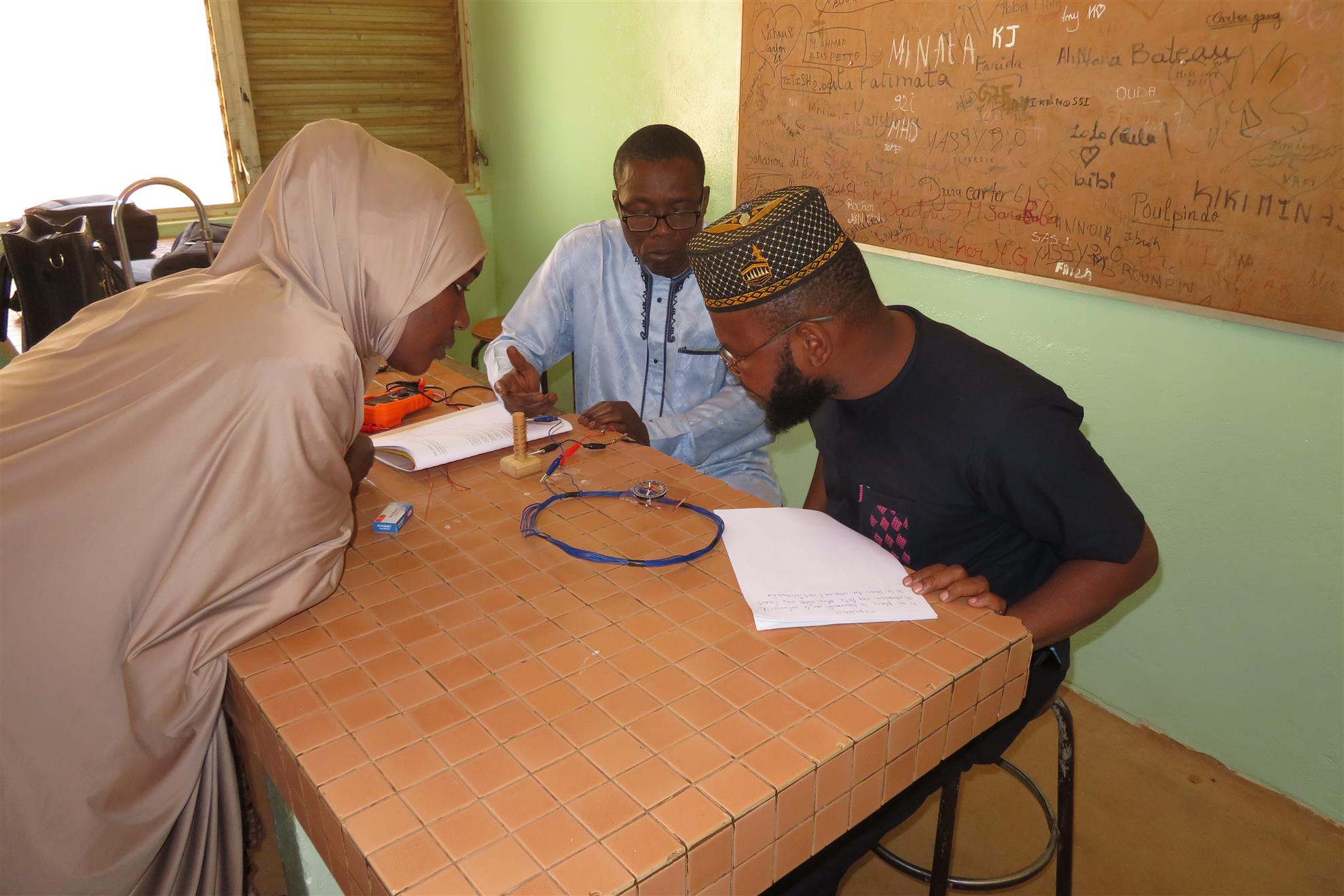
Teachers are the direction of the magnetic field generated by a current in a wire.
The lead teacher in blue is demonstrating the right-hand rule.
Understanding basic principles of electromagnetism is essential for building and repairing electric motors.
Photo from 2023 workshops in Niger.
Lessons carried from one project to the next
Previous projects in Senegal and Niger have helped shape the Togo program.
Early teacher workshops were scheduled for three full days, with Rotary providing lunch. Smith said the current model of four hours of training each day for five days has worked better.
Teachers can return home for lunch, which reduces costs and has improved participation.
Past projects also revealed that some rural classrooms do not have electricity.
For the Togo grant, Rotary and its host-country partners selected schools with electricity available in the classrooms.
Smith believes future projects should consider developing scaled-down laboratory manuals and experiment kits for smaller rural schools with very limited resources.
The earlier projects have also shown that the value of teacher training cannot be measured only by the number of people who attend a workshop.
One trained teacher may work with hundreds or thousands of students over the course of a career. That teacher may also mentor colleagues and train those who enter the profession later.
For now, the Togo project can be measured in 46 science kits, approximately 70 teachers, 23 schools and six tightly packed boxes waiting to leave Pagosa Springs.
“We invest in humanitarian aid because caring for all is an essential part of modern humanity,” Smith said. “And because it benefits us.”